

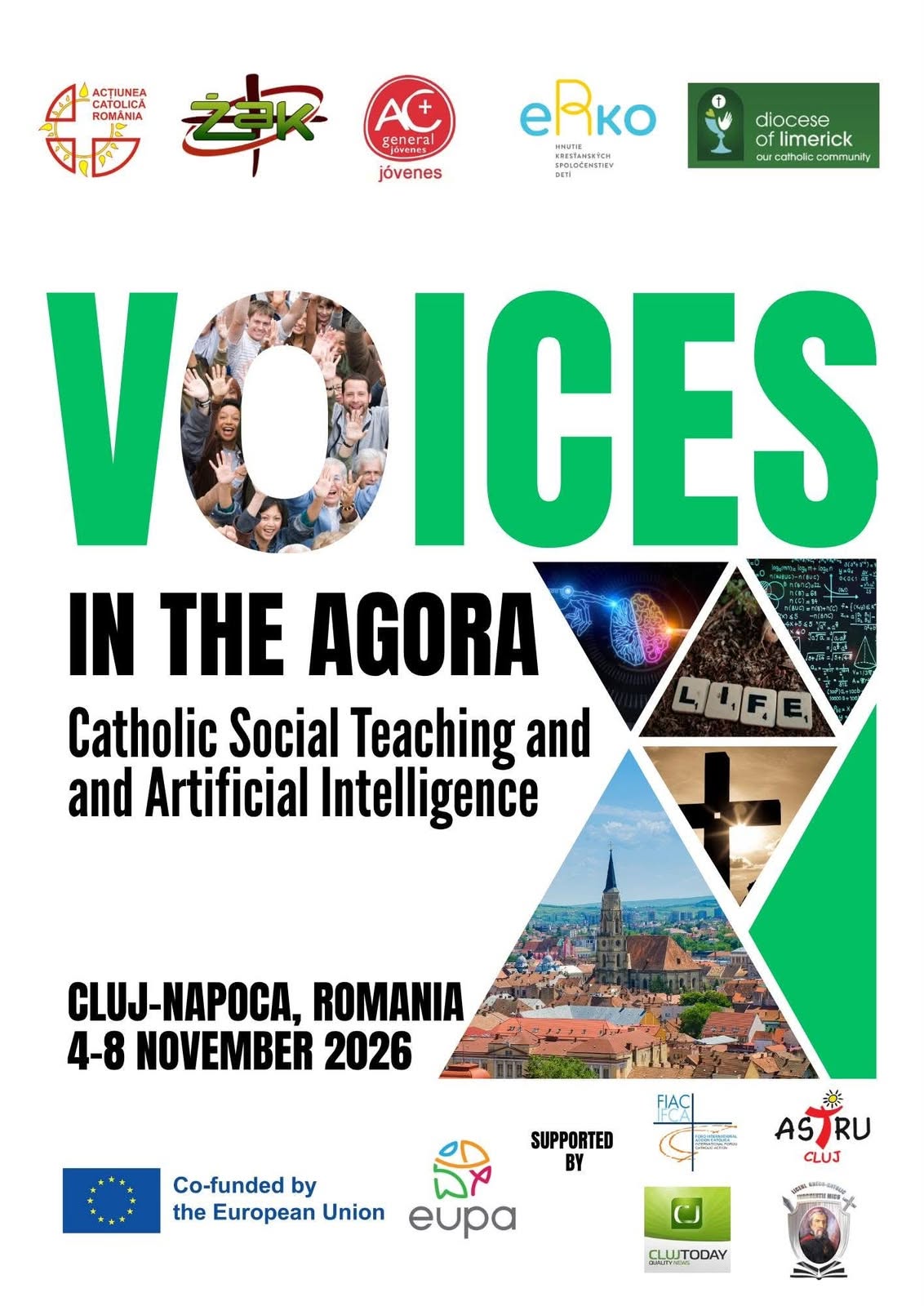
From November 4 to 8, 2026, the Manresa Spiritual Center in Cluj-Napoca hosts “Voices in the Agora,” an international Erasmus+ meeting on artificial intelligence and the Social Teaching of the Church.
What should we never delegate to a machine? How do we remain human in a world where algorithms choose our news, complete our sentences, and influence our decisions? These are the questions 42 young people from Ireland, Malta, Romania, Slovakia, and Spain bring with them to Cluj.
Over four days, they will listen, debate, and work together to understand how we can live alongside artificial intelligence without losing what makes us human. The starting point is the encyclical Magnifica Humanitas by Pope Leo XIV.
 A timely topic, seen through the lens of faith
Artificial intelligence has already entered young people’s daily lives: at school, at university, at work, and on social media. The meeting in Cluj does not aim merely to explain how these technologies work, but above all to ask what they mean for the human person.
Answers are sought in the Social Teaching of the Church, with its principles on the dignity of the person, the common good, and each person’s responsibility toward others. Participants are invited to read the first chapters of Magnifica Humanitas before the meeting. In this encyclical, Pope Leo XIV opened this reflection for the whole Church.
The project’s name alludes to the agora, the public square of the Greek city-states, where people gathered to discuss and decide together. Today, the agora is largely digital, and the question running through all four days is whether technology can serve the common good and what role young people have in this.
42 young people, five countries, one agora
The participants are young people from Catholic Action in Ireland, Malta, Romania, Slovakia, and Spain. Most are between 16 and 25 years old and are high school or university students. For many of them this is not their first international project: some have already taken part in Erasmus+ youth exchanges.
The Romanian group is largely Greek-Catholic, while the other delegations are mostly Latin-rite. This diversity is reflected in the program, which includes both the Holy Liturgy in the Latin rite and the Byzantine Divine Liturgy. The working language is English.
The program: from questions to action
Each day has its own theme, and the three working days follow a clear path: from the human person, to the digital public space, then to each participant’s concrete commitment.
Thursday, November 5 – The Human Person in the Age of Artificial Intelligence
After the official opening, Codruța Fernea, President of Catholic Action Romania, begins the series of presentations with “Who Are We?” Fr. George Claudiu Tuțu, a Greek-Catholic priest of the Eparchy of Cluj-Gherla, pastor of the “St. Nicholas” Parish in Florești, and researcher at STAR-UBB, then answers the question “What Is the Social Teaching of the Church?”
In the afternoon, Susana Dragomir, a strategic communication expert, speaks about “Truth in the Age of Artificial Intelligence.” This is followed by the workshop “The Human Test – What Should Never Be Delegated to Artificial Intelligence?”, and the day ends with the International Evening.
Friday, November 6 – The Digital Agora
The second day is dedicated to information and critical thinking. Claudiu Pădurean, a journalist with experience in national and international media and editor-in-chief of ClujToday.ro, gives the presentation “Who Shapes What We See, Think, and Believe?” Bianca Pădurean, a journalist and co-founder of Via Cluj TV, speaks about “Critical Thinking in the Age of Artificial Intelligence.”
In the afternoon, participants go out into the city for the experiential workshop “The Digital Agora – Can Technology Serve the Common Good?” The evening continues with the Divine Liturgy in the Byzantine rite, dinner in the city, and an evening walk through Cluj.
Saturday, November 7 – From Voices to Action
Alina-Maria Balaj, academic PR officer at the Pontifical University of the Holy Cross in Rome, delivers the conference “Humanity at a Crossroads: Artificial Intelligence, Synodality, and the Call to Build the Common Good” online. This is followed by “Thematic Discussions: What Kind of Digital Future Do We Want to Build?”
In the afternoon, in the “Action Lab – From Voices to Action,” ideas become concrete projects. The final working session, “The Final Agora – Personal Commitment: My Voice, My Responsibility,” gathers each person’s commitments. The day ends with Holy Mass, dinner, and the closing ceremony.
More than conferences
Each day follows the same rhythm: a conference, group discussions, practical workshops, and a moment of reflection. The method is participatory: the young people do not just listen, but ask questions, test, discern, and look for answers to real situations from their digital lives.
Prayer sets the rhythm of the days. The program includes morning prayer, Holy Mass in the Latin rite on Thursday and Saturday, and the Byzantine Divine Liturgy on Friday evening, so that each participant gets to know the other’s tradition.
The meeting also has a side of joy and friendship. At Thursday’s International Evening, each delegation brings food, music, and traditions from its country, plus a game, song, or dance in which everyone takes part. On Friday evening, after dinner in the city, the young people have the chance to discover Cluj, one of the liveliest student cities in Romania.
Organizers, funding, and international and local partners
“Voices in the Agora” is an Erasmus+ project funded by the European Union. The organization coordinating the project is ZAK (Żgħażagħ Azzjoni Kattolika) from Malta. The partner from Romania is Catholic Action Romania, joined by Catholic Action Spain, eRko from Slovakia, and Catholic Action Ireland. The host of the meeting is the Manresa Spiritual Center in Cluj-Napoca. The organizers are also joined by three local partners: ASTRU Cluj, the “Inochentie Micu” Greek-Catholic High School, and ClujToday.ro. The project also has the support of FIAC, the International Forum of Catholic Action.
My voice, my responsibility
“Voices in the Agora” starts from the conviction that young people are not just users of technology, but people who can decide how it is used. Young people are encouraged to take part in the public discussion about technology. They learn to form their own opinion about artificial intelligence and to defend it with arguments, in their communities and online.
The theme of responsibility appears on every day of the program. Participants discuss what information they believe and share, what decisions they leave to a program, and how they can use technology to help others. At the end, each person takes on a personal commitment, which they carry forward into their parish or youth group.
The young people will receive the Youthpass certificate, which recognizes what they have learned through the Erasmus+ project. The certificate lists the competences developed during these days, such as critical thinking, communication, and teamwork with young people from other countries. The document helps them consolidate their skills and knowledge and can be used for job applications or when enrolling in courses or studies.
After the event, Catholic Action Romania will publish photographs, the participants’ impressions and testimonies, as well as the conclusions of the meeting.